Optimizing Performance Through Correct Specification
Many specifiers fall into the trap of treating plain bearings as a commodity design element, opting for the same product time and time again, with little regard for the application. Correct plain bearing specification is essential to achieving optimum performance, reliability, and service life.
Here, Paul Mitchell, Managing Director, explores the importance of correct plain bearing specification when it comes to optimising performance and helping to reduce bearing downtime, both planned and unplanned.
With many more material and design options to choose from than one might expect, it could be said that plain bearings are plain by name but not by nature. For design engineers who work in a closed field specifying component parts for a specific environment, specifying plain bearings can become a tick-box exercise. However, the same can’t be said for aggressive or unusual applications, where it is far more important to select your bearings on a project-by-project basis.
The problem often starts when a designer relies on the same bearing even though the application has evolved – the loads get bigger, the speeds get faster, or another variable is introduced such as a change in chemical exposure, the withdrawal of adequate lubrication, or reduced maintenance access. A bearing is a small part with a big responsibility and, like all components, it has a limit. The key is to re-specify, rather than push the boundaries of the bearing you are accustomed to using.
Specifying the Right Plain Bearing
The guiding principle for an engineer is that the bearing is the wear element and therefore the shaft must be made of a harder material than the bearing. Knowing the shaft material and its performance properties before commencing plain bearing selection is crucial and, combined with that all-important consideration of cost, your manufacturer or distributor of choice will be able to assist you in making the right choice for each project.
There are a huge number of variables at play when selecting the right bearing and, if you are using a shaft which has not been rated by your bearing supplier, then many of the commonly used lifetime calculations will still leave margin for error when it comes to marrying the right shaft with the right bearing.
One of the main parameters used in correct plain bearing specification is the Pressure Velocity Ratio (PVR), the relationship between load and speed, which can give an indication of the wear that is likely. Like all lifetime calculations, however, it doesn’t offer a complete picture, so further investigation into the load and speed is essential. The type of load, whether intermittent or continuous, and whether there is a shock load to consider, are all important factors, as well as the coefficient of friction and the lubrication within the system.
Bearing manufacturers have invested heavily in research and development in recent years and we are really starting to see the benefits as an industry. New alloys have been introduced, along with new techniques for manufacturing, testing and fault analysis, giving engineers a more comprehensive bearing specification guide than ever before.
Two Market-Leading Solutions
For many harsh or demanding applications, choosing either a self-lubricating bearing or one manufactured from a state-of-the-art load-resistant alloy can provide optimised performance where many conventional bearings would simply fail.
Let us look at these two potential solutions in more detail.
Self-Lubricating Bearings
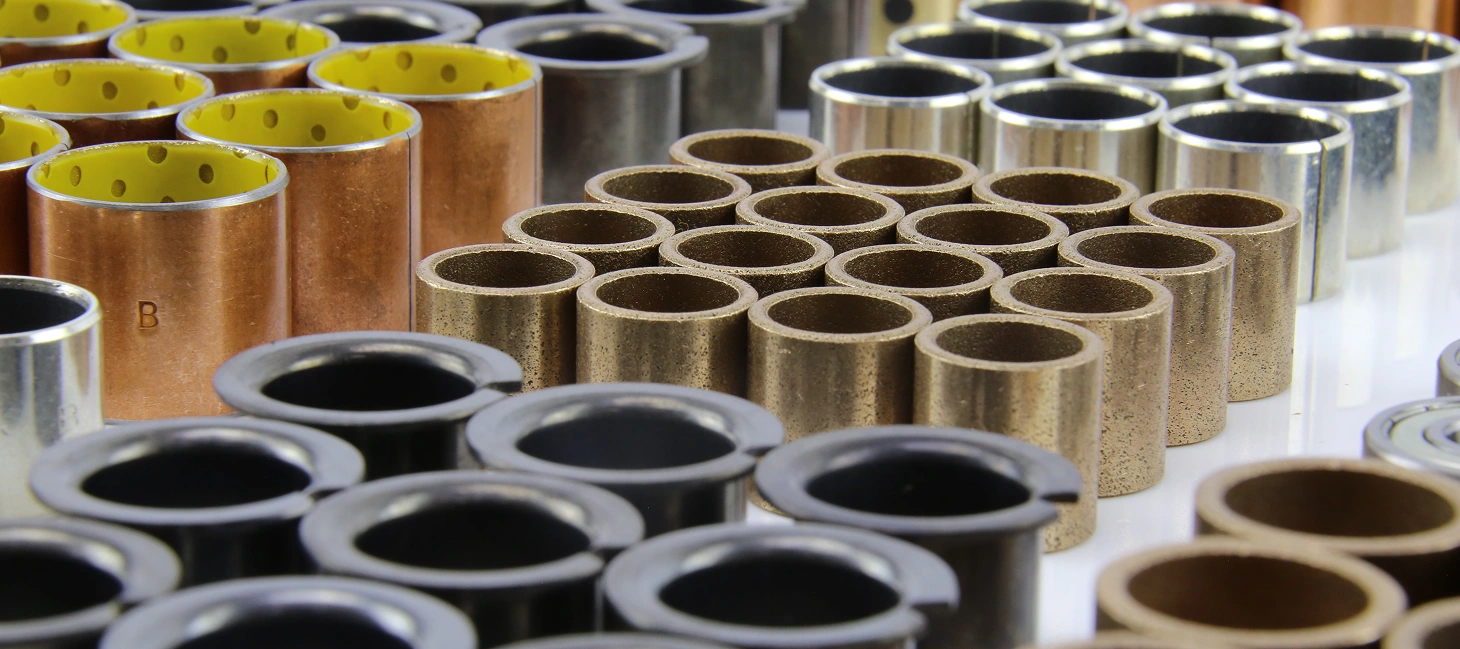
Self-lubricating bearings, like Bowman’s Oilite® range, are also referred to as graphite plug bearings because they are lubricated for life with solid graphite plugs.
With lubricating graphite mechanically forced into holes throughout the bearing, a film of lubrication is transferred onto the shaft when operation begins, providing continuous lubrication over long periods without maintenance.
With the capability to withstand high temperatures up to 425°C (800°F) and cryogenic temperatures down to -200°C (-400°F), they are ideally suited for applications where no external lubrication can be provided, where oil or grease would carbonise, or where bearings operate while immersed in water.
This includes high-temperature applications such as ovens, kilns, dryers and injection moulding machines. Wet applications include submerged pumps, textile finishing, chemical processing, water turbines and lock gates—all hostile environments that are difficult to access for servicing, making a maintenance-free solution highly attractive.
Bowman is the only supplier of the original and genuine Oilite® bearings in Europe, recognised as the market leader in self-lubricating bearings for almost 80 years.
Higher Load Capacity Bearings
Manufacturers worldwide continue to invest in higher load capacity bearing technology. Bowman’s BowMet® range has been hailed as the biggest advancement in plain bearings in more than 70 years, offering higher load capacity and longer service life than comparable bearings, together with outstanding heat, speed and corrosion performance.
Its static load capacity of 820 N/mm² is unrivalled for plain rolled bearings.
This enables BowMet® bearings to deliver the load capacity required for the heaviest applications and harshest operating environments, from agricultural machinery, construction plant and large marine vessels to motorsport vehicles, cranes and many other demanding applications.
Manufactured from ToughMet®, an advanced alloy developed by Materion in the USA, BowMet® delivers increased bearing reliability, reduced maintenance requirements, fewer warranty claims and helps reduce bearing downtime across a wide range of industries. At the same time, it offers the flexibility, reduced material wastage and no minimum order quantities associated with standard rolled bearings.