John Handley Bearings to Launch Revolutionary New Range of Split Bearings
Two Reasons Not to Ignore the Joint Gap When Installing a Split Bearing
When you need a new bearing installed quickly, it can be tempting to overlook small details such as the visible joint gap on the inner race halves and clamp rings—but don’t. Correct bearing clearance is essential for reliable bearing performance and long service life.
Here’s why.
No Joint Gaps Can Indicate a Problem
The joint gap ensures that the inner race halves are clamped tightly to the shaft. If there are no visible joint gaps, it may indicate that the shaft is undersized or that the incorrect bearing size has been selected, affecting the required bearing fit.
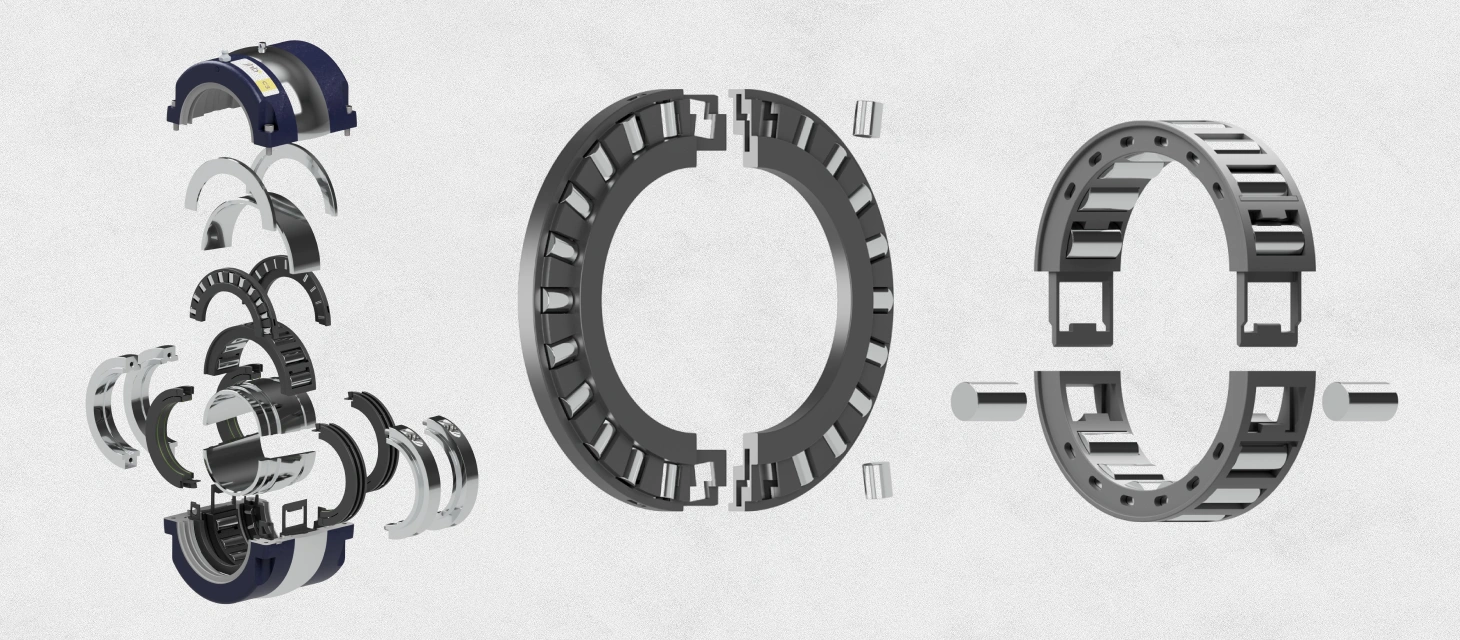
The bore of the Bowman Split Bearing inner race is manufactured to the same size and tolerance as the shaft. The joint gaps are cut at an angle, allowing each roller to pass progressively over the joints without affecting bearing performance. These gaps confirm that the two race halves are not touching. When the clamp rings are fully tightened, the race is securely fixed to the shaft while maintaining the correct bearing tolerance.
If you do not have visible gaps at both joints, something is wrong. Stop the installation immediately and contact your bearing supplier for technical support.
Installing a Bearing with No Joint Gaps Will Result in Damage
If there are no joint gaps during installation, or if the bearing gap has been set incorrectly, the race halves will press against each other as the rollers pass over the joint during operation.
The result can be fractured joint faces, causing particles of the inner race to break away and enter the bearing. This debris can create additional wear, leading to further damage and potentially premature bearing failure.
It is usually easy to identify a bearing that has operated with incorrect joint gaps, as both faces of the contacting joint will display visible damage.
Getting It Right
To help optimise bearing clearance, maximise bearing life and reduce unnecessary downtime, follow these best practice guidelines:
Pay close attention during the initial fitting of the inner race halves. Use feeler gauges to check and equalise the joint gaps before fully tightening and applying the specified torque to the clamp ring screws.
Soft, compressible packing may be used to maintain a gap but ensure it does not protrude beyond the joint face. If it enters the roller path, it may interfere with roller rotation, while material entering the bore may prevent the inner race from seating correctly on the shaft.
The joint gaps should generally be around 0.5 mm on each side, depending on the accuracy of the splitting operation.
Aim to keep the joint gaps equal. Where this is not possible, ensure there is still a gap at each joint, even if the distribution is approximately 60/40 or 70/30.
The clamp rings are manufactured with similar joint gaps to ensure the full clamping force is transferred to the shaft. Apply to the same installation practice used for the inner races, noting that the clamp ring joint gaps are typically around 1.0 mm on each side to achieve the correct running clearance.
No Gap, No Operation
The message is simple: if there are no joint gaps, the bearing should not be put into operation.
Ignoring this critical aspect of bearing clearance explained can significantly reduce bearing life, resulting in premature replacement, increased maintenance costs, and unnecessary downtime.
If you’ve experienced a breakdown and need support quickly, get in touch with our team. We maintain substantial stock inventory and may be able to reduce your lead time considerably.
The launch of the new John Handley split bearings marks a significant milestone in split bearing technology. John Handley Bearings (JHB) is set to unveil its revolutionary split bearing range at the BearingNet User Meeting at the Hilton Hotel & Convention Centre in Warsaw, Poland. Already generating excitement across the industry, the new split roller bearing launch introduces innovative engineering backed by eight new patents, delivering substantially higher load capacities, improved maintenance, and greater installation flexibility.
Moving with the Times
Split roller bearings have long been recognised for improving efficiency, reducing downtime, and simplifying maintenance in applications where shaft access is limited. However, despite their proven reliability, the core design has remained largely unchanged since 1907. As industrial machinery continues to evolve, demand for higher load capacities and improved performance has increased, leaving many traditional designs struggling to keep pace.
The new John Handley split bearings are designed to overcome these limitations. While retaining all the benefits of conventional split bearings, the new split bearing range delivers significantly greater capacity, improved flexibility, and easier installation and maintenance for modern industrial applications.
A Collaborative Approach
As part of the Bowman Group, John Handley Bearings has worked closely with Bowman Additive Production to rethink split bearing design using advanced 3D printing technology. Rather than making incremental improvements, the engineering team redesigned the bearing around its most critical component—the cage.
The result is the patent-pending Rollertrain® cage, which dramatically improves performance. Compared with conventional designs, it delivers up to 70% higher radial load capacity and up to 1000% greater axial load capacity, making it one of the most significant advancements in Bowman split bearings technology. The innovative cage has already received industry recognition through its nomination for the Industrial Product Application Award at the TCT Awards.
These increased capabilities allow a single bearing series to replace three existing series, simplifying product selection while expanding application coverage.
Independent Axial Load Performance
Traditional split roller bearings primarily accommodate radial loads, with axial capacity remaining limited. This often forces engineers to compromise when specifying bearings for demanding applications.
The new John Handley split bearings overcome this challenge by independently accommodating both radial and axial loads. This breakthrough allows engineers, for the first time, to accurately calculate axial L10 bearing life, providing greater design flexibility and improving long-term reliability in high-load applications.
Disrupting the Split Bearing Market
The introduction of this new split bearing range represents far more than a product update. By combining advanced engineering with additive manufacturing, John Handley Bearings has created a solution that significantly improves load capacity, durability, maintenance efficiency, and installation simplicity.
For design engineers and maintenance teams, the new bearings provide a practical alternative to traditional split bearings while reducing downtime and improving operational performance. The split roller bearing launch also demonstrates how Bowman split bearings continue to push innovation within the bearing industry.
The new range will officially launch at the BearingNet User Meeting in Warsaw, where the senior management teams from John Handley Bearings and Bowman Group, including Managing Director Paul Mitchell, Technical Director Ian Breeze, and Commercial Director Lucie Tait Harris, will be available to discuss the technology and its applications.
To learn more about the new John Handley Bearings split bearing range and how it can improve your application, get in touch with our team today.