
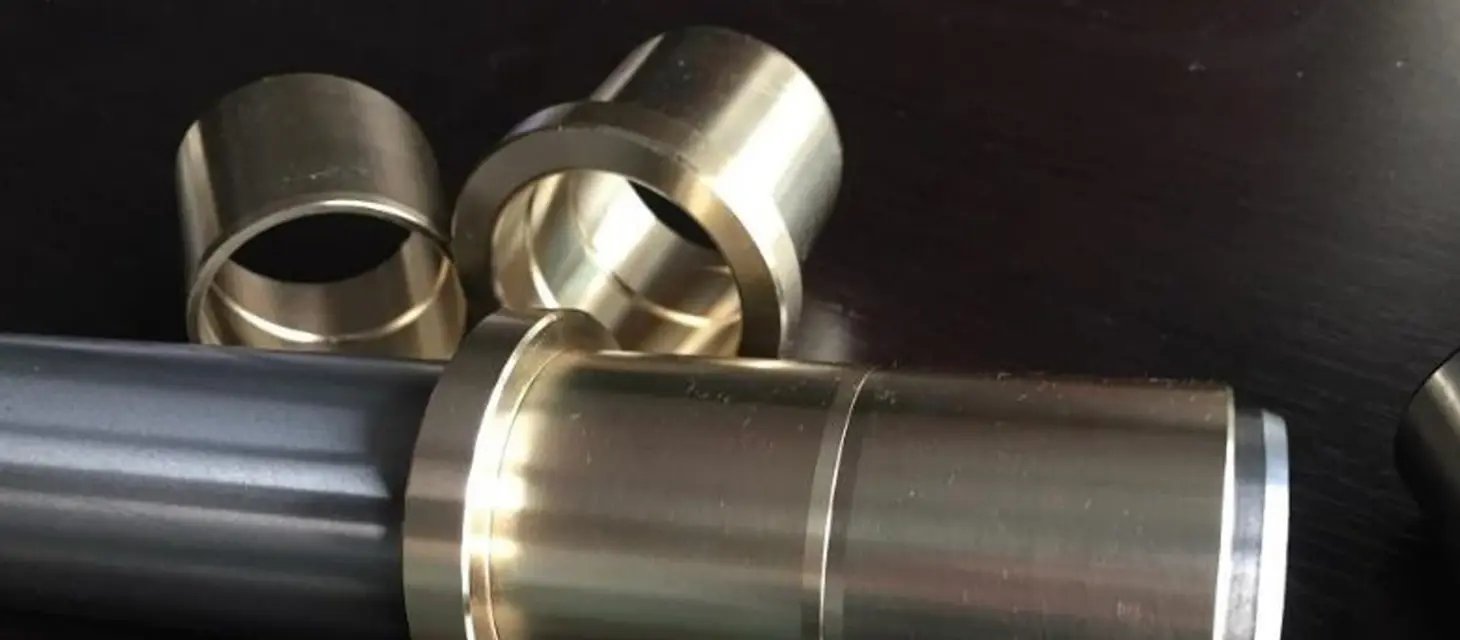
Better results with a harder shaft
This week we will be looking at why a bronze plain bearing is much more reliable with a hardened shaft than it is with a soft shaft. Understanding the relationship between shaft hardness bearings is essential for improving bearing performance and service life. So, let’s get started.
Hardening through heat treatment involves heating the metal to a sufficiently high temperature to dissolve impurities. Steel is usually heated to between 800°C and 900°C before being rapidly cooled, or “quenched,” in either water or oil.
The key advantage of hardening a shaft is that it enhances the durability of the metal. This means the shaft can better withstand wear, pressure, damage, and fatigue, resulting in a longer service life.
Now let’s look at why you should use a bronze plain bearing with a hardened shaft.
Having a bronze plain bearing running on a hardened shaft offers several advantages. The bronze plain bearing has a lower coefficient of friction with a hardened steel shaft than it would with a softer shaft. Because the steel shaft is more resistant to corrosion, wear and heavy-duty operation once hardened, the bronze plain bearing adapts to the smoother shaft surface finish and lasts considerably longer.
On a softer shaft, the rougher surface can become damaged over time, which may chip away at the bronze plain bearing, leading to increased plain bearing wear, fractures and fatigue. Selecting the correct shaft hardness for bearings is therefore an important part of achieving long-term reliability.
Hardness Testing Methods
How many different types of hardness testing do you know? If you guessed three, then congratulations; you are correct.
There are three main types of hardness testing:
Rockwell Hardness Test
The Rockwell Hardness Test is the most common method of measuring metal hardness. It is also the quickest and most economical compared to the other two methods. It requires very little material preparation, and the hardness value can be read easily without additional equipment. Some might even say it’s faster than the blink of an eye. Obviously it isn’t—but you get the idea!
Brinell Hardness Test
The Brinell Hardness Test was the first widely adopted hardness test. It measures the indentation left in the material and is commonly used for surfaces that are too rough for either the Rockwell or Vickers methods.
However, it is not suitable for fully hardened metals and leaves a relatively large impression on the material. It is also the slowest of the three testing methods.
Vickers Hardness Test
The Vickers Hardness Test is the most accurate of the three methods and uses a diamond-tipped indenter while requiring less applied force.
However, it also requires an optical measurement system and significantly more material preparation, making it more expensive and time-consuming than the Rockwell method.
Why Shaft Hardness Matters
When selecting the correct bearing shaft material, engineers should consider not only hardness but also wear resistance, corrosion resistance and the quality of the bearing counterface. A hardened shaft with an excellent surface finish allows plain bearings to perform more efficiently, reduces wear, and extends component life.
Choosing the appropriate combination of shaft material and bearing material is one of the simplest ways to improve equipment reliability and reduce maintenance costs.
By George Nasi | Sales Engineer